


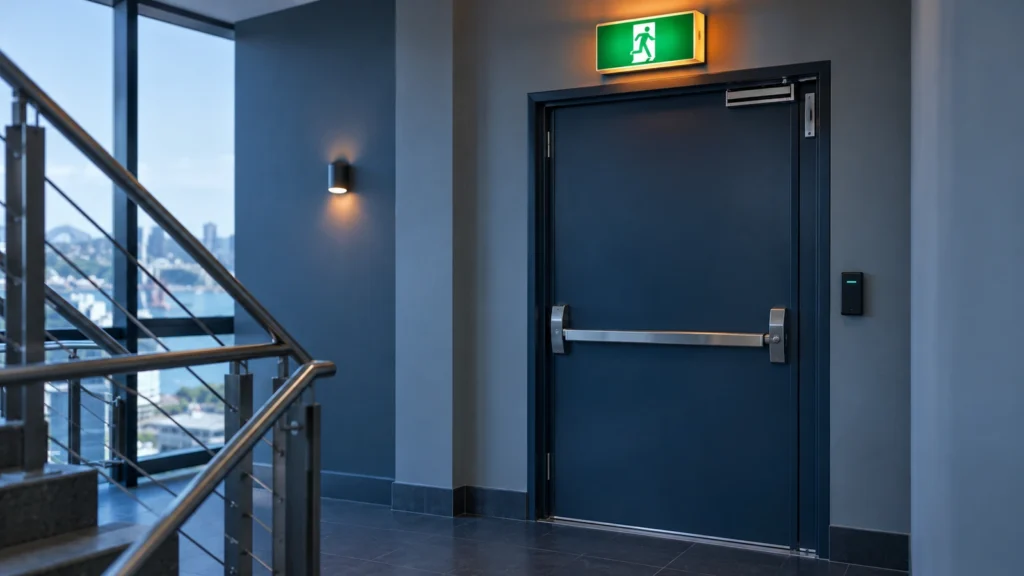
If you own, manage or specify a building with access-controlled fire doors, there is one question worth asking before the tender goes out: what exactly is a “fire trip”? On many projects nobody has defined it. When the specification leaves it open, the most competitive tender usually wins, and that is usually a software solution. Here is why that matters, and what to ask for instead.
When “Fire Trip” Means Nothing Until Something Fails
On large critical infrastructure projects, security integrators are routinely engaged to tie access-controlled doors into the building’s fire system. The pattern is familiar. As part of the building’s occupancy requirements, fire doors are expected to release when the fire alarm activates. The integrator takes a single output from the fire indicator panel, lands it on one input of the access control system, and programs a rule: when that input is active, unlock every door on a “fire door list”.
It works on commissioning day, it passes the functional test, and it is cheap to deliver. The problem is what it quietly assumes: that the access control system is alive and healthy at the moment it is needed.
What The NSW Framework Expects
In NSW, the starting point is the National Construction Code (NCC), as adopted in the state, together with the state’s fire safety certification regime.
Egress doors under the NCC. Section D3D26 deals with the operation of latches on doors in a required exit, doors forming part of a required exit, and doors in a path of travel to a required exit. The Australian Building Codes Board’s guide to D3D26 explains that the clause allows for buildings fitted with automatic fail-safe devices that are triggered by another active system. The guide is clear about the conditions behind that allowance: the device must be genuinely fail-safe, which would include during a power failure, and access to the exits must be enabled immediately, with effectively no time delay. The guide also notes that D3D26(5) treats Class 9b buildings differently from the usual provisions. States adopt the NCC with their own variations, so check the NSW edition for the exact wording that applies to your project.
The fire safety certification regime. NSW councils describe the fire detection and alarm system and fire doors as essential fire safety measures under the Environmental Planning and Assessment (Development Certification and Fire Safety) Regulation 2021. The same council page says the building owner carries ultimate responsibility for maintaining them, and that the assessment behind each annual fire safety statement must be carried out within the three months before the statement is issued. Published NSW fire safety statements on the NSW Planning Portal show the alarm system measured against AS 1670.1 and fire doors against AS 1905.1. One council’s statement template also highlights offences relating to fire exits, doors relating to fire exits and paths of travel to them.
The practical consequence is that the door release is not just a commissioning detail. The doors and the alarm system are part of what is assessed and signed off every year, and the owner is accountable for them.
Fail-Safe And Fail-Secure, In Plain Terms
A fail-safe lock unlocks when power is removed. A fail-secure lock stays locked. Magnetic locks are normally fail-open, which means that in a power-to-lock installation the door is held shut only for as long as the lock circuit stays energised.
For that kind of door, the fire strategy comes down to one question: how reliably can you guarantee that the lock loses power when the building is on fire?
The Three Levels Of Fire Trip
It helps to name the levels, because they behave very differently under failure. This framework reflects industry practice and field experience rather than a published standard.
Level 1: Software Release
The fire panel’s relay feeds an input on the controller, and a rule in the access control software unlocks the doors on a list. It is cheap and flexible, and it is the weakest level, because it works only if the controller, its firmware, its database and its network are all functioning.
Level 2: Hardwired Power Interruption
The fire relay breaks the supply to the lock circuit itself, independent of controller logic. This is much better than software, provided the lock supply is genuinely routed through the relay.
Level 3: Mechanical Release
A device at the door, such as push-to-open hardware or a manual emergency release, frees the door whatever the electronics are doing. It is the level that fits most naturally with the ABCB guide’s expectation of a release that is immediate and that works through a power failure.
The Failure Nobody Specifies
Here is the scenario that rarely makes it into a design brief. Suppose the fire starts in the access control system itself, for instance in the controller room or the power supply cabinet. The logic that was supposed to run on the fire input is now sitting inside the very equipment that is compromised. If the controller is damaged, hung or offline, the software rule never executes, and the doors are never told to release.
If the fire then spreads beyond the controller room, the doors stay as they were: locked. They only release once the lock circuit loses power altogether.
So when does the power actually go? On a large site the main controller may sit on a single circuit that trips from the fire or an overload. In most cases the backup battery then carries the system. Even with the mains circuit tripped and the building burning, the battery can keep the locks energised, which for a power-to-lock installation means holding them locked. Only when the batteries are exhausted, potentially hours later, does a power-to-lock door finally release. Hours is not a timescale that matters in an evacuation.
This battery behaviour is a field observation of how backup supplies typically sustain a system, not a figure from a standard. Actual autonomy depends on battery sizing and load at each site.
Set against D3D26, the problem is plain. An arrangement that depends on a controller surviving a fire is hard to describe as genuinely fail-safe, and the ABCB guide expects access to be enabled immediately, not hours later.
What To Ask For
If you are writing a specification, reviewing a tender or signing off a building, this is what a defensible design looks like.
- Define “fire trip” in the specification. State which level or levels are required, what is being interrupted (controller input, lock power, or the door itself), and what happens on controller failure. Do not leave it for the tenderer to interpret.
- Do not rely on software as the only release. A software door list is a convenience layer for logging and alerting, not a sole path.
- Make the lock supply fail when the fire panel does. If the fire panel drops voltage, the entire lock circuit should lose voltage. The relay that does this must sit in the lock power path, ahead of any controller or battery that could keep it alive, and should be proven at commissioning by genuinely isolating the controller.
- Treat mechanical release as the baseline. For any door where a fire trip is required, the mechanical release at the door is the one measure that does not depend on power, software or networks. Hardwired and software releases are layered on top.
- Test the failure case. Commissioning tests normally trigger the fire panel with the access control system healthy. Add a test with the controller powered down or disconnected, and confirm that the doors still release.
- Plan for the annual assessment. Because the alarm system and fire doors are assessed each year as part of the annual fire safety statement, document how the release works so that the assessor can verify it.
- Confirm with the certifier. Requirements depend on the building class, the NCC edition and any alternative solutions listed in the fire safety schedule, so agree the final arrangement with the certifier and the relevant authority.
In Summary
A software fire trip answers the question “what should happen when the alarm sounds and everything works?” Critical infrastructure design has to answer the harder question: “what happens when the alarm sounds and the access control system is the thing that failed?” For any installation that has to protect lives, the honest answer is that the mechanical release cannot be defeated by a dead controller, and any design that calls itself a fire trip should be built around it.
If you are planning access control for a building with fire doors, get in touch and we can talk through how the release should work before the specification is locked in.
This article is general information, not engineering or legal advice. Confirm requirements against the NCC edition and NSW provisions that apply to your project, and with your certifier.